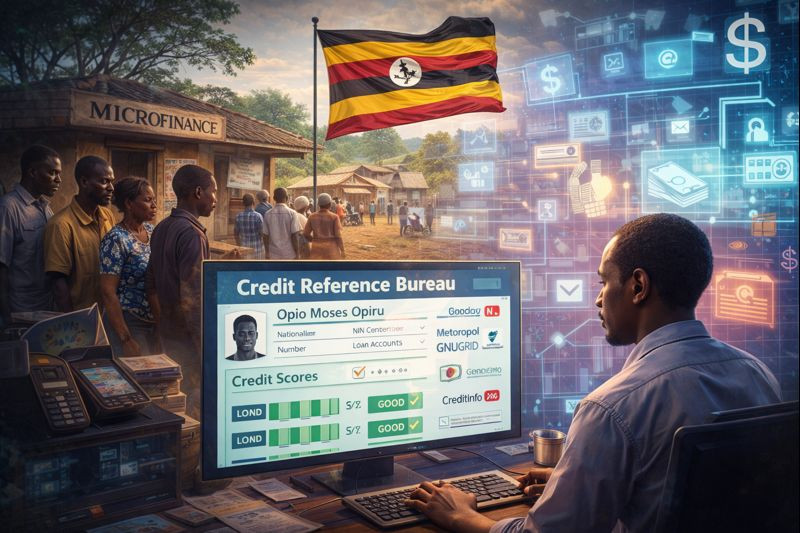
Why a comprehensive Credit Reference Bureau is the next trigger of responsible lending in Uganda’s microfinance sector. – Paul’s Diaries Microfinance Series – Part II
When I began writing this second article in my Microfinance series, the first title that came to mind was “When interventions in the informal sector mean more interruptions.” This was inspired by the UGX 3.26 trillion government investment into the Parish Development Model and the recent extravagant donations to various SACCOs by the re-elected President, many of them formed along social, professional, and political lines. These interventions, though well intentioned, were implemented without clear long-term mechanisms for measuring impact, evaluating sustainability, or ensuring that beneficiary SACCOs remained regulated, properly managed, and revolving funds twelve months after disbursement. I later realised that such a title would make this article sound more political than objective, and I therefore chose instead to focus on what I believe is the single most powerful but underutilized tool available to Uganda’s financial sector today: comprehensive credit reporting through Credit Reference Bureaus.
If deliberately embraced, this single tool could transform microfinance and banking into a more responsible, honest, and data-driven part of the economy. Credit reporting in Uganda was introduced in 2008, yet for nearly a decade its coverage remained narrow, capturing mostly commercial bank borrowers. By 2018, only about one to two million individuals were registered, and almost all records originated from banks. It was not until the Financial Institutions (Credit Reference Bureau) Regulations of 2022 that credit reporting began to make practical sense for the broader microfinance sector. These regulations sought to widen coverage and bring into the fold all accredited credit providers, including UMRA-regulated money lenders, SACCOs, and Tier 4 microfinance institutions.
Following these regulations, CRBs such as Metropol, GnuGrid, and CreditInfo shifted from the old Financial Card Number system to the National Identification Number as the unique borrower identifier. This significantly improved data integrity and borrower tracking. As of January 2026, the number of borrowers registered with CRBs has increased from about 2.9 million before the 2022 regulations to approximately 4.1 million unique borrowers. This growth demonstrates the potential power of structured data when regulation and technology align. Credit must be given to the Bank of Uganda for ensuring near-comprehensive credit reporting among commercial banks, MDIs, and mobile money lenders. What remains unclear is how the Microfinance Regulatory Department, formerly UMRA, will capture and enforce data submission from money lenders, SACCOs, and Tier 4 microfinance institutions, which serve the largest and most active borrower population in the country.
Microfinance institutions are short-term credit providers. They disburse more frequently, to more people, and in smaller amounts than commercial banks. This makes them the busiest segment of Uganda’s lending ecosystem and therefore the most critical for building a responsible credit culture. Bank of Uganda reports show that mobile money loans disbursed during the financial years 2023–24 and 2024–25 amounted to UGX 1.66 trillion and UGX 3.5 trillion respectively. The 2024 figure alone rivals the combined lending of several commercial banks in the same year. For comparison, Pearl Bank disbursed UGX 700 billion, Finance Trust Bank UGX 356 billion, Pride Bank UGX 250 billion, Cairo Bank UGX 178 billion, and Uganda Development Bank UGX 388 billion. These figures demonstrate the enormous scale of the informal and digital credit market.
MTN Mobile Money alone reported that its unique borrowers grew from 3.5 million in 2024 to over 8 million in 2025. Based on this trajectory, it is reasonable to predict that combined MTN and Airtel loan disbursements for the financial year 2025–26 may surpass Stanbic Bank’s UGX 4.1 trillion lending reported in 2024. This growth confirms two important truths: that microfinance has become a powerful economic engine and that Uganda has a historic opportunity to anchor this growth in responsible lending through structured credit reporting.
In recent years, government has channelled vast sums of public money into SACCOs through various initiatives, including Seven Hills SACCOs, ghetto structure SACCOs, mechanics’ SACCOs, musicians’ SACCOs, comedians’ SACCOs, and wedding MC SACCOs. While these allocations aim to stimulate income generation, they often bypass established formal channels such as the Microfinance Support Centre or government-owned banks and microfinance institutions like Pride Bank, Finance Trust Bank, and Pearl Bank, which already operate under clear regulatory and reporting frameworks. Formal channels impose conditions such as minimum years of operation, audited books, proper member databases, and revolving fund accountability. In contrast, many newly formed or loosely structured SACCOs dissolve after receiving funds, leaving no traceable financial history and no reporting to Credit Reference Bureaus.
A more structured approach would encourage sector-based SACCOs rather than fragmented social groupings. Just as Wazalendo SACCO serves the army and Exodus SACCO serves police officers, garage operators could form one national SACCO, musicians another, and market vendors another. Such SACCOs would design tailored financial products, maintain reliable databases, and report borrower behaviour through CRBs to the financial system. This would turn informal sectors into traceable, bankable economic units rather than temporary political recipients of funds.
Over the last three financial years, taxpayers have committed UGX 3.261 trillion to the Parish Development Model through more than 10,594 SACCOs. Before that, the Emyooga programme disbursed UGX 390 billion to over 6,748 SACCOs. Government records indicate that more than four million informal sector business owners benefited from these interventions. These programmes are commendable in intent, but without financial education, structured monitoring, and integration into CRB systems, they risk reinforcing the belief that government funds are political gifts rather than economic obligations.
The Attorney General’s 2023–2024 report on the Parish Development Model highlighted weaknesses in monitoring systems, unclear priority setting in many parishes, limited accountability, and difficulty in measuring poverty reduction outcomes. These findings point directly to the absence of a strong credit discipline architecture. If beneficiary SACCOs were required to submit periodic repayment data to CRBs and if persistent defaulters were flagged across the system, the narrative would change from entitlement to responsibility. Lending would become behavioural rather than political.
Uganda already possesses the tools required to build a responsible microfinance market driven by validated data rather than sentiment. What remains is the will to enforce comprehensive credit reporting across SACCOs, money lenders, and Tier 4 microfinance institutions. A functioning CRB ecosystem would protect lenders, reward disciplined borrowers, and guide public interventions toward sustainable empowerment rather than temporary relief. It would transform the informal sector into a transparent, bankable, and accountable contributor to national development. The next trigger of responsible lending in Uganda’s microfinance sector is not more money, but better data.
Written by
Paul Kasobya
Founder, Paul’s Diaries
Head of Operations, Afriqapital Ventures Ltd
(Tier 4 Microfinance Institution, Uganda)
[email protected]
+256 751 545 331
Share this post: